
Raytown City Directory Holdings
Historical research starts with the collections that can be verified, then with the limits of each one. Midwest Genealogy Center holds directories, telephone books, yearbooks, maps, newspapers, state and county records, and extensive microform. Its Missouri directory microform list confirms several statewide and gazetteer publications. It does not confirm a printed Raytown-specific run, a publisher, or a sequence of years. Treat the broader collection as a lead for a name or address, and verify the actual volume before recording a household.
| Historical collection | Known years | Where held | Access route |
|---|---|---|---|
| Missouri and Illinois State Directory | 1854-55 | Midwest Genealogy Center microform | Collection and catalog research; Raytown coverage is unverified |
| Missouri State Gazetteer and Business Directory | 1860 | Midwest Genealogy Center microform | Collection and catalog research; Raytown coverage is unverified |
| Missouri State Gazetteer and Business Directory | 1889-90 | Midwest Genealogy Center microform | Collection and catalog research; Raytown coverage is unverified |
| Raytown Historical Society binders | Collection-specific | Raytown Historical Society and MGC gallery | Call ahead and cite the binder, item, and page |
| Jackson County collection, MGC 1015-JCM | 1894-2001 | Midwest Genealogy Center | Five boxes, open for research under the finding aid |
A missing catalog result is not evidence that a person was absent from Raytown. It may mean the relevant volume was not cataloged at that level, the name was spelled another way, or the person appears in a different kind of local record. The verified gap matters: do not invent a Raytown-specific run or attach a named resident to one without the scanned page or catalog record.
Directory Dates Before Raytown
The confirmed Missouri directory runs predate Raytown's incorporation on July 17, 1950. That comparison changes the search approach. A person tied to the place before incorporation may be filed under Jackson County, a rural route, a nearby postal label, a school, a landowner, or a Kansas City area reference rather than under a city heading. Old records should retain their original place wording until another source proves the match.
This is also a useful local quirk. The official history material describes 63rd Street being widened into Blue Ridge Boulevard in 1911, with 63rd Street later becoming a common name again. Search both forms, plus an intersection or legal description, before deciding that an address is missing from a historic directory lead. A historic label is evidence, not a typo to silently modernize.
Raytown City Directory Research at MGC
Midwest Genealogy Center's research page describes the shelf around a directory search: newspapers, maps, yearbooks, family histories, geographic databases, staff help, and in-library Ancestry Library Edition. The center has microfilm readers and a larger historic collection than the local branch. Use the same spelling variants in its directory, newspaper, and map searches, then preserve the collection title and page with every result.
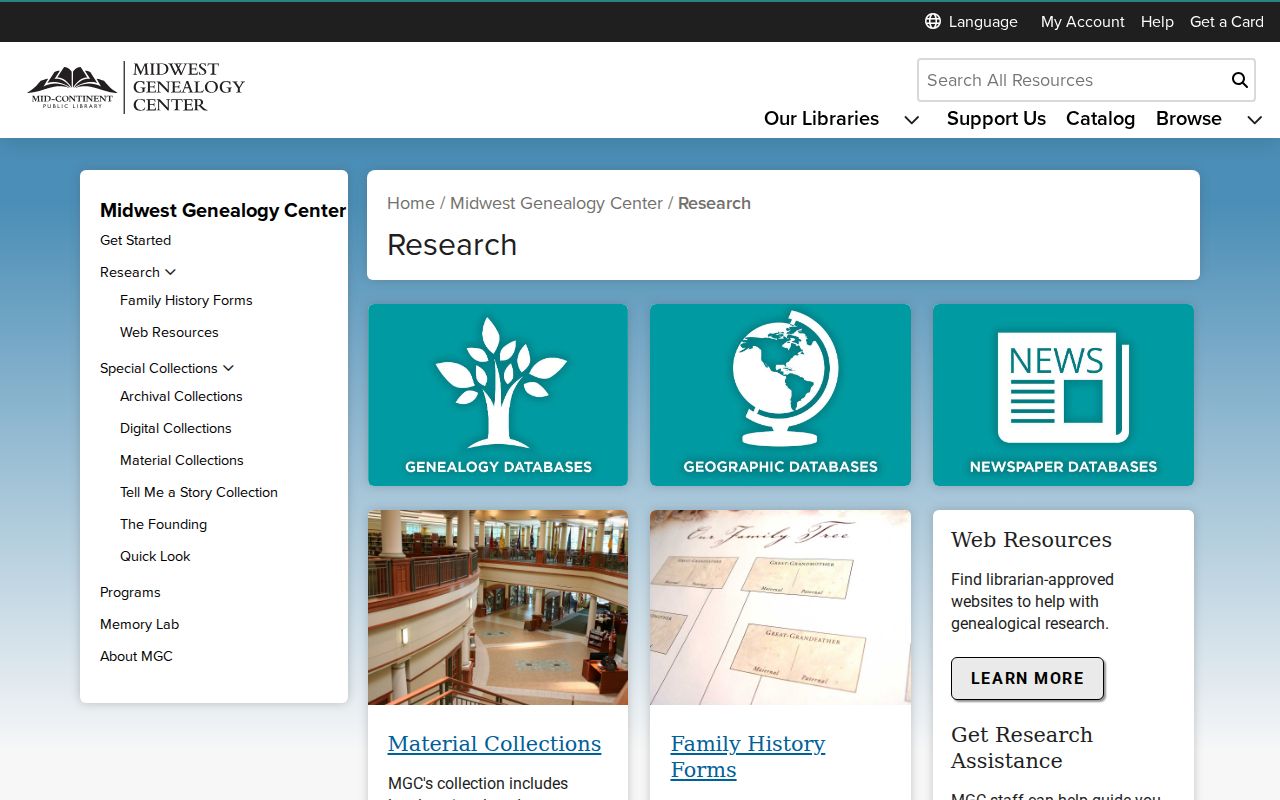
The research screen reflects why one volume is only part of the trail. A directory hit can be checked against a news notice, map, yearbook, obituary, or county record without treating one short printed line as a full biography. For local access to computers, copying, scanning, and referral, the Raytown branch is at 6131 Raytown Road.
For deeper collection work, MGC is at 3440 S Lee's Summit Road in Independence and lists 816-252-7228. Its extensive historical holdings include directories, phone books, newspapers, Missouri county histories, land-sale material, maps, and census resources. Much of its microform is not fully cataloged, which is a reason to ask staff for a collection or format search rather than treating a web-catalog miss as final. The center's guidance also emphasizes spelling variation and source citation, both essential when a Raytown name appears only in a dated historical item.
Raytown Historical Society City Volumes
The Raytown Historical Society finding aid identifies City Volumes I-III alongside binders for mayors, police history, schools, families, early businesses, aerial views, maps, and Flanery/Frost Cemetery. These are strong historical leads when no confirmed directory volume is available. The research center is at 9705 E 63rd Street, and the listed phone is 816-353-5033. Call ahead before relying on an item being available.
The binder list is a finding aid, not proof that every subject has been digitized or indexed by name. Record the binder or series title, item date, page, URL, and retrieval date. The digitized Officials 1950-2000 item can place a mayor or city official in a period, but it is not a current residence roster.
Reading a Raytown City Directory Lead
No official source reviewed reproduces a Raytown-specific printed entry or its abbreviation key. Instead of borrowing conventions from another city, inventory what the actual page shows. The record below is a capture checklist, not a claim that every field occurs in a Raytown volume. Photograph the key or front matter before interpreting a symbol, and keep the original spelling even if a later record uses a different form.
| Directory identity | Title, publisher, edition year, page, and city or street section. |
|---|---|
| Printed name | Exact spelling, spouse or household notation, and any cross-reference. |
| Place field | Address as printed, including street-name variant or rural wording. |
| Printed activity field | Organization or occupation field, if the original entry includes one. |
| Marks and image | Any owner or occupancy notation, abbreviation key, and the image or catalog URL. |
- Criss-cross directory
- A directory arrangement that lists entries by street or address rather than by surname. Its existence for a particular Raytown volume must be checked in that volume.
- Householder index
- A name-led arrangement that may identify a household contact. It does not establish continuous residence or a complete household.
- Abbreviation key
- The volume's own explanation of shortened terms and symbols, usually in front matter or another keyed page. Capture it with the entry.
Raytown Names in School Material
The MGC Jackson County collection is cataloged as five boxes covering 1894-2001 and includes a Raytown series with school and event material. An official digitized local-history list identifies Raytown High School yearbook inserts from 1958 through 1961. These sources can place a name in a dated class, program, or event. They should be cited by school, year, page, and collection identifier, and they should not be read as proof of a current address.
School material is especially helpful beside a directory lead with an uncertain name. Compare initials, graduation period, an old street name, a newspaper notice, or a cemetery record before connecting two similar names. The matched date and institution are more useful than a broad assumption based on a surname.
The same collection includes a student directory, football program, graduation invitations, and school publications. Each can provide a narrow date and institutional setting. Record only what is printed on the item, including a partial name or an uncertain date, then look for an independent record that explains the connection. A graduation invitation or program can confirm an event, but it does not supply a complete family history or a modern address.
Tracing Raytown City Directory Households
A historical volume works best as a sequence of dated snapshots. Begin with one confirmed page, then move to adjacent available years instead of jumping across decades. Pair the directory with the appropriate released census schedule and other evidence. Midwest Genealogy Center notes a seventy-two-year census restriction and holds historic census material, so availability depends on the period and collection.
- Start with the earliest page that names the person, address, school, or organization and capture the full citation.
- Check the next available directory or companion record for the same spelling, a variant spelling, and any street-name change.
- Compare the address wording with a map, plat, or deed description before joining it to a modern location.
- Pair the date with a released census schedule, then compare household names and relationships rather than relying on a name alone.
- Use newspapers, obituaries, cemetery materials, or probate and land records to test a disappearance from the trail.
A name that no longer appears can signal a move, a death, a new listing style, an unindexed volume, or no directory coverage at all. The Missouri State Archives death database is a useful closing check for certificates from 1910 through 1975, with image and index results where available. Its pre-1910 abstract search provides a separate older route.
Raytown City Directory Follow-Up
For a death or family transition, Missouri State Archives lets researchers search the death collection by deceased person, spouse, father, or mother, with name operators, a year range, and county. Related-person searches have their own stated date limits. The Archives warns that transcriptions and original images can be difficult to read, so an image should be checked when one is available.
Jackson County Historical Society is another route when an MGC or Historical Society lead needs deeper archival help. Its research-request process requires an appointment and at least one week of notice, with no walk-in research. In-person research has no charge; staff research is listed at $25 per hour, while copies have separate listed fees. Confirm current fees before ordering. Note: A directory lead becomes reliable only when its exact collection, date, and page remain attached to the claim.
When the question reaches a cemetery or a family transition, ask for the specific binder, register, or collection rather than requesting a broad name search. The Raytown Historical Society finding aid identifies Flanery/Frost Cemetery material, while MGC and the Historical Society may hold related local-history leads. City retention material says cemetery registers, deed books, and interment record cards moved to state general schedules in a 2018 packet, so current custody should be confirmed before a visit or order. The Archives also cautions that older transcriptions and originals can contain errors or illegible writing. Keep that uncertainty in the citation instead of silently filling in an unclear historic printed name.